
My Husband Kept Saying Our Daughter Was Faking Her Illness to Waste Money—Until I Secretly Took Her to the Doctor and the Scan Revealed a Frightening Reality.
For weeks, our fifteen-year-old daughter, Maya, had been fading away in small, terrifying ways. It started with sudden nausea, then a sharp, persistent pain in her abdomen, followed by dizzy spells that left her clinging to the hallway walls for support. The active girl who used to play soccer until sunset had completely vanished into oversized gray sweats and a protective silence.
Across the dinner table, my husband, Robert, didn’t even bother looking up from his smartphone. To him, fear over money didn’t make him careful—it made him deeply cruel. “She’s putting on an act,” he declared with a flat, final coldness. “Teenagers make everything a drama. We are absolutely not wasting money on useless hospital visits.”
But a mother’s intuition doesn’t listen to a man’s financial greed. At 2:13 a.m. on a rainy Monday, I found Maya curled tightly on her bedroom floor, clutching her stomach and weeping in absolute agony. That was the breaking point. The very next afternoon, while Robert was still safely at work, I secretly signed Maya out of school and rushed her straight to the emergency wing at Riverside Medical Center.
By 3:08 p.m., the medical team had fast-tracked an urgent ultrasound. I kept Robert’s frantic text messages facedown on my lap, my hands trembling as the room filled with the quiet electric hum of the medical machines.
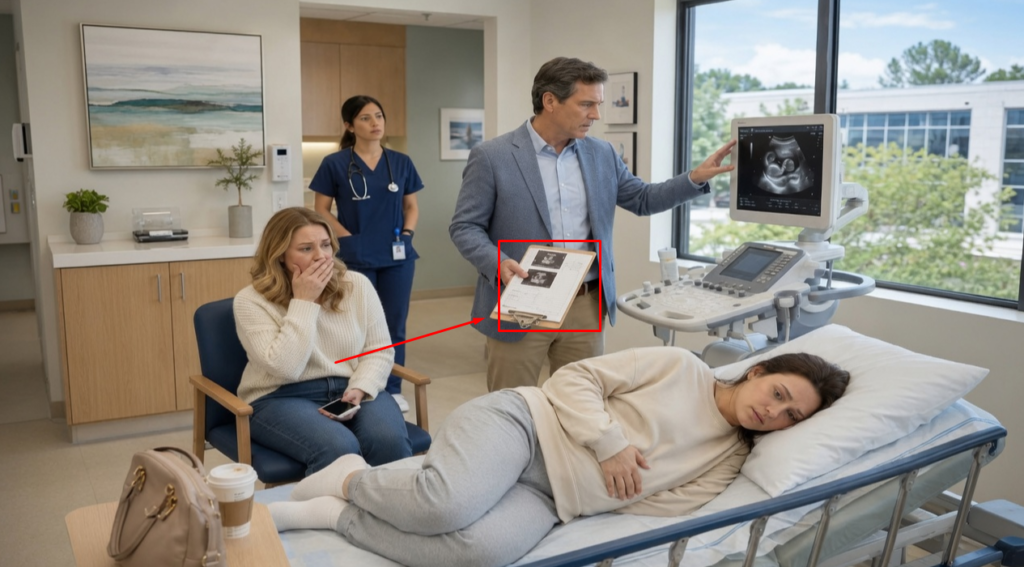
When Dr. Lawson stepped into the exam room, his posture was incredibly tense, clutching a clipboard tightly against his waist. He walked directly over to the ultrasound monitor and pointed a stern finger at the pale, distinct shape captured on the black-and-white screen.
“Mrs. Thorne,” Dr. Lawson said, his voice dropping to a heavy, serious tone that made my heart stop. “The scan shows there is something very specific inside her. We need to run immediate blood confirmations before I say this out loud.”
The world around me completely shattered. I sat paralyzed in the bedside chair, instinctively clamping my hand over my mouth as silent, horrified tears flooded my eyes. Behind the doctor, a nurse in dark blue scrubs watched us with a grim, sorrowful expression, knowing exactly what that shape meant.
On the hospital bed, Maya lay weakly on her side, her hand resting protectively over her swollen abdomen, looking up at us with exhausted, frightened eyes. She wasn’t carrying a tumor, and she wasn’t faking her pain for attention.
The scan clearly revealed a highly advanced, thirty-week-old fetus—a secret pregnancy resulting from a traumatic assault at a school camp months ago that Maya had been too terrified to speak out loud, locked in a home where her father treated every cry for help as a financial burden.
As the realization washed over me, the phone in my hand buzzed violently again. It was another angry text from Robert, demanding to know why I was wasting his money. I deleted his message, gripped my daughter’s freezing hand, and prepared for the battle ahead.