The Silent Headstone: A Mother’s Eternal Agony
The autumn wind howled through the barren branches of the Blackwood cemetery, carrying with it a bitter, bone-chilling cold. The ground was covered in a thick blanket of decaying, damp leaves that squelched beneath any footstep. It was a place forgotten by time, isolated on the edge of a dense, suffocating forest. Here, far from the comfort of the town, stood a solitary grey headstone.
I collapsed onto my knees before it, the cold mud soaking through my heavy winter jacket, but I couldn’t care less about the physical discomfort. The pain tearing through my chest was a thousand times worse. I buried my face in my hands, sobbing so violently that my entire body shook. My hands were covered in dirt and dried leaves, a stark reflection of how unraveled my life had become over the last twelve months.
Exactly one year ago today, my twin seven-year-old sons, Leo and Oliver, vanished from our backyard without a trace. After a frantic three-month search, the local authorities found two unidentifiable, badly burned bodies near a riverbank. They handed us a closed casket, told us it was our boys, and closed the case. My husband, David, knelt in the mud just a few paces behind me, his hand resting on my shoulder, his face hollowed by a year of sleepless nights and unanswerable questions.
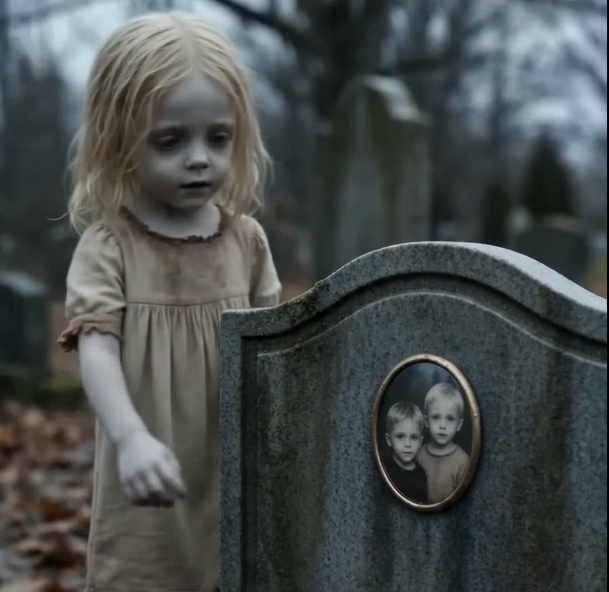
Embedded into the cold, mossy granite of the tombstone was a small, gold-trimmed oval portrait of our boys. In the photograph, they were smiling, their arms slung around each other’s shoulders—so full of life, so innocent. I stared at their frozen faces through a blur of hot, heavy tears, wishing more than anything that I could wake up from this endless nightmare.
The Apparition in the Mist
As my cries echoed through the quiet graveyard, the air suddenly grew heavy and intensely cold. A thick, pale fog rolled in from the treeline, obscuring the distant monuments.
Through the shifting white mist, a figure began to materialize.
David noticed it first, his grip on my shoulder tightening so hard it bruised. I raised my tear-stained face from my hands, my breath hitching in my throat. Walking slowly, almost weightlessly over the damp leaves, was a little girl. She couldn’t have been older than six. She wore a simple, old-fashioned beige dress that was tattered at the hem, and her skin was an unnatural, porcelain pale. Her long blonde hair hung loosely around her face, framing eyes that looked far too old and hollow for a child.
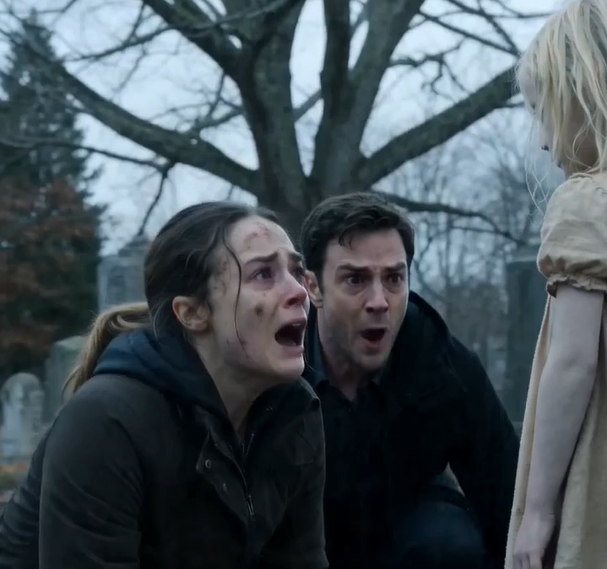
She didn’t look like the living children of our town. She looked like a memory, a spirit trapped between worlds.
The girl didn’t say a word as she approached our boys’ grave. She ignored David’s defensive stance and stepped right up to the cold granite stone. Slowly, she raised her frail, pale right arm and extended her index finger, pressing it firmly against the glass of the oval photograph containing Leo and Oliver.
The silence that followed was suffocating. I could hear the rapid, frantic pounding of my own heart against my ribs.
“They’re not gone,” the girl whispered. Her voice didn’t sound like it came from her mouth; it sounded like it echoed directly inside my head, cold, soft, and chillingly clear.
My jaw dropped, a fresh tear spilling over my cheek. I stared at her in absolute, paralyzed awe. Behind me, David took a sharp, ragged breath. He leaned forward, his voice trembling violently with a mixture of fear and a sudden, dangerous spark of hope.
“What… what did you say?” David stammered, his eyes wide with disbelief.
The little girl slowly turned her head toward us. Her dark, hollow eyes locked directly onto mine, holding my gaze with an intensity that froze the blood in my veins.
“They stay with me,” she replied softly, her small finger still resting on the portrait of my missing sons.
The Secret of Blackwood Orphanage
A desperate, wild gasp escaped my lungs. I crawled forward on my hands and knees, dragging myself through the mud until I was just inches away from her dress. I reached out, wanting to grab her, to hold onto whatever sliver of hope she was offering, but my hands hovered in the air, terrified she would disappear like smoke if I touched her.
“Who…?” I choked out, the words burning my throat as my eyes searched her pale face. “Who stays with you? Please, tell me!”
The girl’s lips curved into a faint, sorrowful expression. She leaned in slightly, her voice dropping to a harsh, freezing whisper that shattered the quiet of the graveyard.
“Both of them,” she murmured. “At the orphanage.”
The words hit me like a physical blow. The orphanage.
Just three miles through the dense woods sat the St. Jude Home for Children, an old, Victorian-era orphanage run by a powerful, reclusive local director. It was a place shrouded in rumors, but we had never had a reason to look closer. If our boys were there, it meant the bodies in the grave weren’t theirs. It meant the police, the coroner, and the local officials had lied to us. Our sons hadn’t died in a tragic accident—they had been stolen, their identities erased, hidden away in plain sight while we spent a year weeping over an empty plot of land.
Before the realization could even fully settle in my mind, the little girl stepped backward. The fog seemed to rush toward her, swallowing her pale dress and hollow eyes. Within a fraction of a second, she was completely gone, leaving only the damp leaves swirling where she had just stood.
The Race Against the Dark
The sudden disappearance broke the spell of terror holding us captive. A raw, primal adrenaline flooded through my system, wiping away a year of depression and exhaustion in a single heartbeat.
“Where?!” I screamed at the top of my lungs, pushing myself up from the mud, my face contorted in a mixture of pure fury, desperation, and terror. “Where are they?!”
David didn’t hesitate. He grabbed my arm, pulling me up, his face filled with a terrifying, unyielding determination. “The orphanage, Elena! We’re going right now!”
We turned away from the headstone and began to run. We sprinted through the graveyard gates and broke into the deep, dark woods, tearing through the thorns and thick brush as the shadows of the evening began to close in around us. We didn’t care about the dark, we didn’t care about the danger. Our boys were alive, trapped in a house of horrors, and we were coming to tear it down.