My nephew was halfway inside his mother’s casket when a 285-pound biker dragged him backward and knocked him to the chapel floor, making every relative believe we had just witnessed an unforgivable act.
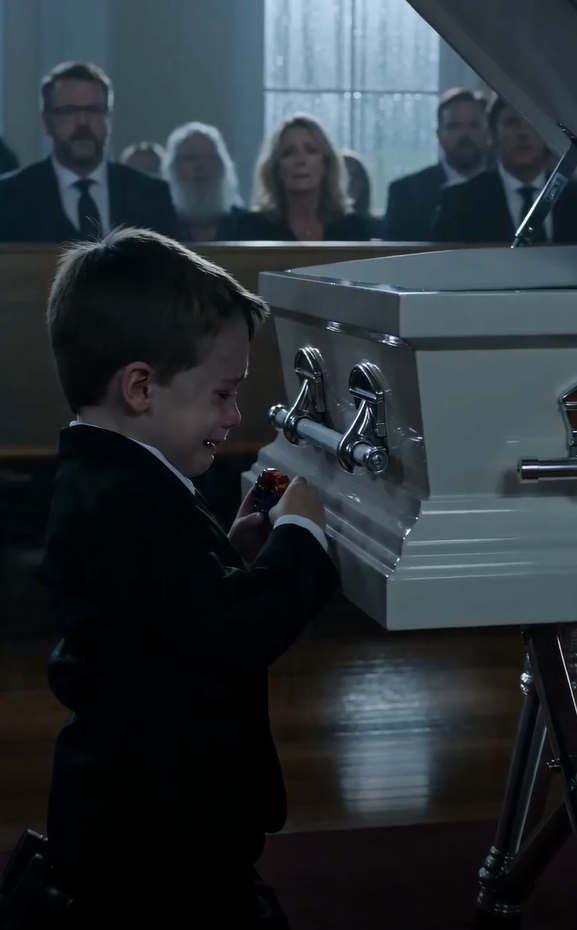
Nobody saw the hinge moving.
I did not hear the metal click beneath the organ, the rain, and Caleb whispering goodbye to the mother he had watched disappear one hospital day at a time.
The biker did.
His name was Ray “Hammer” Dawson, although most of us knew nothing beyond what his appearance suggested.
He was fifty-six, six-foot-four, and nearly 285 pounds, with tattooed forearms, a shaved head, a black-and-gray beard, scarred knuckles, and a plain leather vest.
A dented black Harley waited outside Mercer & Sons Funeral Home. Its cooling engine ticked beneath the chapel windows while rainwater ran from its chrome.
Inside, my sister Sarah lay in an open casket surrounded by white lilies.
She had raised Caleb alone since his father died overseas. During three years of cancer treatment, she prepared schedules, insurance forms, school contacts, and letters for every future birthday she expected to miss.
She could prepare everything except the moment her son had to leave her.
Caleb refused to step away after the service.
He climbed onto the small platform beside the casket and leaned across Sarah’s folded hands, trying to place a plastic astronaut near her shoulder.
The upper lid shifted.
A brass support pin slid farther from its housing, but flowers and decorative fabric hid the movement from everyone standing nearby.
Hammer had remained near the rear doors.
He suddenly ran.
His boots struck the aisle hard enough to turn every head. He reached Caleb, seized him beneath the arms, and pulled him from the platform.
The astronaut fell.
Caleb screamed that the stranger had hurt him. My uncle grabbed Hammer’s vest, while I struck the biker across the face before demanding he release my nephew.
Hammer turned his body away from us.
At first, I believed he was shielding himself.
He was shielding Caleb.
The casket lid dropped behind them.
Wood struck metal with a chapel-shaking crash. The failed hinge snapped free, and the reinforced viewing panel landed exactly where Caleb’s head and shoulders had been.
Several women screamed.
My uncle released Hammer.
I stopped breathing.
Caleb remained inside the biker’s arms, staring toward the closed casket with an expression no eight-year-old should have to carry.
Hammer lowered him onto the carpet.
“You didn’t do anything wrong,” he said.
Caleb’s voice trembled.
“I just wanted to kiss her.”
“I know.”
“You pulled me away.”
“I know.”
Caleb struck Hammer’s chest with both fists.
The biker allowed it.
He did not tell the child he had saved him, demand gratitude, or use danger to make the boy’s grief behave more conveniently.
He remained on one knee until Caleb stopped hitting.
The funeral director blamed an unexpected mechanical failure. Hammer picked up the separated support and exposed a fracture concealed beneath decorative trim.
“This was damaged before delivery.”
The director asked whether he was an engineer.
“No.”
“A funeral professional?”
“Used to assemble caskets at Mid-Ohio Works.”
The director’s face tightened.
Mid-Ohio had issued a safety notice involving certain hinge supports months earlier.
Our casket matched the affected model.
The funeral home had received the notice.
Caleb heard none of that. He kept staring toward the casket, believing the fallen lid meant his mother had disappeared again.
Hammer reached inside his vest and removed a small white ribbon.
Sarah’s name had been stitched across it.
“Why do you have my mom?” Caleb asked.
Hammer closed his fingers around the ribbon.
“Because she helped me say goodbye once.”
Later, I learned Sarah had been the hospice nurse who cared for Hammer’s wife, Caroline. When Hammer refused to enter the hospital room during Caroline’s final hour, Sarah sat beside him on the floor.
She told him goodbye did not require the correct words; it required staying long enough to be present.
He entered.
He held his wife’s hand until morning.
Three years afterward, Sarah called Hammer from her own hospice bed and asked for one promise involving Caleb.
The burial ended near dusk. Hammer left without speaking to our family, but Caleb noticed his Harley disappearing along County Road 8.
At midnight, my nephew vanished.
We found him outside Green Hollow Cemetery, sitting beneath Hammer’s leather vest while the biker guarded the locked gate.
Caleb believed his mother should not spend her first night in the cemetery alone.
Hammer believed children sometimes need company more than correction.
So he stayed.
Inside his saddlebag was Sarah’s final letter, a temporary guardianship document, and one truth about Caleb’s father our family had buried for four years.
PART 2: Shadows of the Iron Gates
Cold cemetery iron guards midnight secrets.
The damp night air of Green Hollow Cemetery smelled of freshly turned clay, crushed pine needles, and the faint, sweet scent of rotting white lilies laid upon the newly buried mound.
County Road 8 was dead silent at midnight, save for the low, rhythmic ticking of a cooling V-twin motorcycle engine parked beside the rusted wrought-iron gates.
When my uncle and I pulled our sedan off the shoulder, our headlights cut two long, blinding beams across the graveyard, illuminating a scene that made my chest tighten with a strange, defensive ache.
Caleb sat cross-legged directly on the cold grass at the foot of Sarah’s grave, wrapped securely inside a heavy, worn leather biker vest that swallowed his small frame completely.
Standing sentinel a few yards away, leaning casually against the iron gate with a cigarette glowing a dull orange in the dark, was Ray “Hammer” Dawson.
He didn’t move as our car doors slammed shut.
He didn’t flick his cigarette away or step forward to intercept us.
He simply watched us with unblinking, heavy-lidded eyes, his scarred knuckles tucked loosely into his jeans pockets.
“Caleb!” my uncle shouted, rushing past the biker without a second glance. “What on earth are you doing out here?! Do you know how terrified your family is?!”
The boy looked up, blinking against our headlights, his face pale and tear-stained.
“I couldn’t leave her, Uncle David,” Caleb whispered, his voice trembling in the night air. “She’s alone out here.”
“She’s gone, son, and this man has no business taking you away from your home in the middle of the night!” my uncle barked, reaching down to yank Caleb up by his arm.
“Don’t touch him like that,” a low, gravelly rumble cut through the dark.
Hammer didn’t raise his voice, but the weight behind his words made my uncle instantly freeze.
The biker pushed off the iron gate, standing to his full six-foot-four height, casting a long, intimidating shadow across the dew-soaked turf.
“He was cold,” Hammer said plainly, pointing a scarred thumb toward the vest wrapped around the boy. “And he wanted to make sure his mother’s first night wasn’t spent in an empty room.”
“He belongs with his family, Mr. Dawson,” I said, stepping between them, my voice shaking slightly as I looked up into the biker’s weathered, unreadable face. “Not wandering off with a stranger we barely know.”
Hammer stared down at me for a long, uncomfortable moment.
Then he reached inside the inner pocket of his heavy leather vest, pulled out a sealed white envelope, and tossed it gently onto the hood of our sedan.
“You don’t know me, Ms. Mercer,” Hammer said quietly. “But your sister knew me better than anyone else in this county. And before you start screaming about kidnapping, I suggest you open that envelope.”