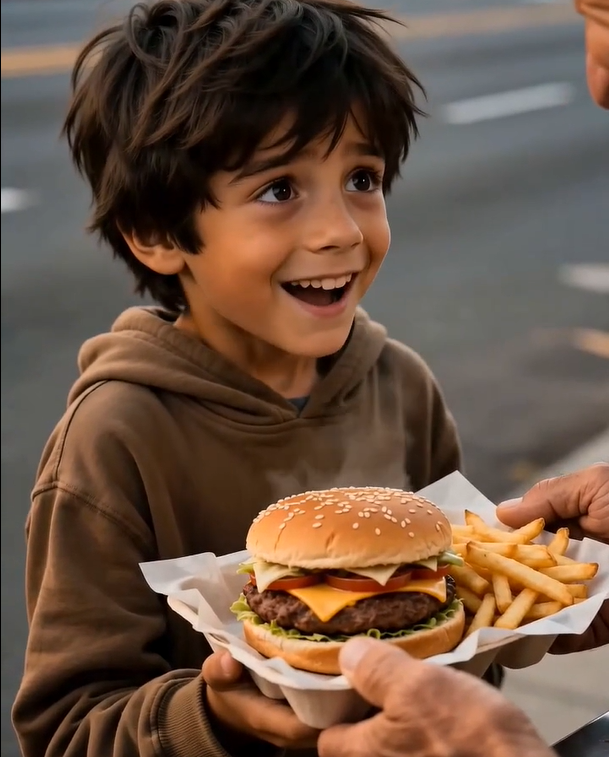
Twenty years ago, I was a starving orphan counting pennies for a single burger, but the kind street vendor smiled, handed me a full meal, and whispered: “Eat. You don’t need money.”
The memory had never faded. It was autumn in New York City, and the freezing wind off the river cut straight through my oversized, tattered brown hoodie. I was only seven years old, carrying a plastic bag filled with aluminum cans I had collected from gutters just to trade for a few cents. My stomach was a hollow, aching void. I had stood by the edge of the sidewalk, staring longingly at a smoking street cart filled with sizzling hot dogs and thick, juicy burgers.
With trembling fingers, I had extended my hand toward the elderly vendor, showing him the only three worthless coins I possessed. I expected him to shout at me, to tell me to get lost like every other shopkeeper had that day.
Instead, the old man’s eyes crinkled with genuine warmth. He looked at my soot-stained face, gently pushed my hand away, and placed a steaming platter containing a massive cheeseburger and a pile of golden fries into my small palms.
“Eat,” the old man had whispered softly, his voice full of grandfatherly tenderness. “You don’t need money.”
A bright, tearful smile broke across my face. As I took my first bite, the world didn’t feel so cold anymore. I looked up at him through my tears and made a solemn vow: “I’ll never forget this.”
Twenty years passed.
The old man, Arthur, continued to run his humble food cart against the backdrop of the shifting city skyline, his hair turning completely silver, his spine bending slightly under the weight of time. He watched the city change, but he remained, a small anchor of kindness in a ruthless metropolis. He often wondered what had happened to the little orphan boy with the aluminum cans, praying the child had survived the harsh streets.
At sunset on a crisp autumn evening, a gleaming, top-of-the-line black luxury sedan slowly pulled up to the curb right next to Arthur’s cart. The door clicked open, and a young executive stepped out onto the pavement. He was wearing a flawless, custom-tailored three-piece suit, polished Italian leather shoes, and carried a sleek black briefcase.
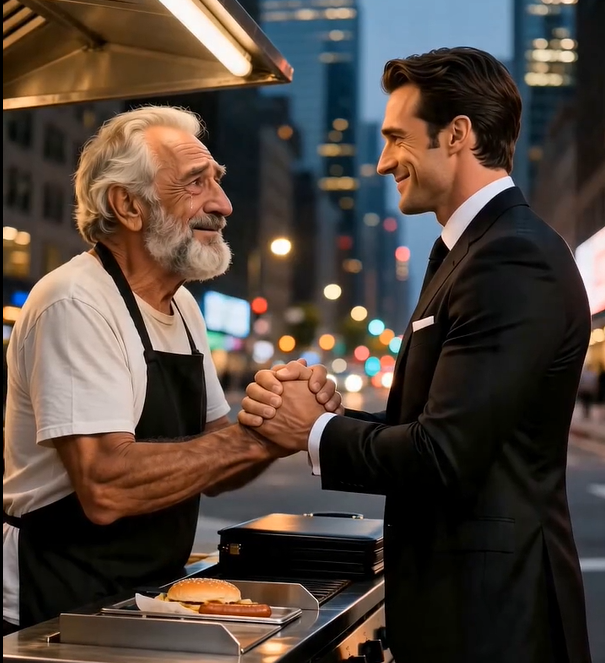
Arthur looked up from his grill, preparing to offer his standard polite greeting to the wealthy businessman. But as the man walked closer, the executive stopped, looked at the old man’s weathered face, and smiled the exact same bright, unforgettable smile from twenty years ago.
“I told you I would never forget, Arthur,” I said, my voice thick with emotion.
Arthur’s jaw dropped. His old, calloused hands began to shake as he recognized the piercing eyes of the starving boy he had fed two decades prior. Before he could speak, I stepped forward and tightly gripped his hand in a powerful, emotional handshake that bridged twenty years of hardship and success.
After leaving his cart that night, the memory of Arthur’s kindness became the driving force of my life. I studied under streetlamps, secured scholarships, and fought my way to the top of the financial world, eventually becoming the CEO of one of the largest investment firms in the city. But I didn’t return just to say thank you or hand him a tip.
I placed the heavy black briefcase onto his stainless-steel counter and opened it. Inside were the signed, legal deeds to a brand-new, fully equipped restaurant space located in the heart of Manhattan—fully paid for, under Arthur’s name.
But the true depth of my payback wasn’t just the restaurant; what Arthur didn’t know as he stared at the deeds was that the briefcase also contained a document that solves his family’s biggest medical crisis.